BEJN (IN BETWEEN)
Gwangju Biennale
Art Polygon Horrangassy
Gwangju, South Korea, 2026
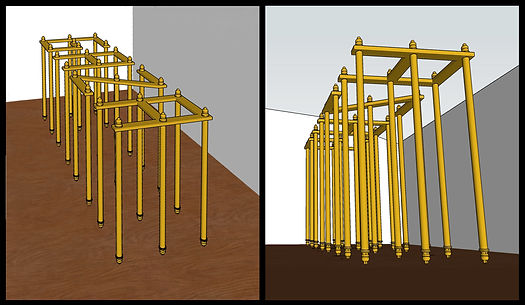
PERISTYLE Installation with 50 x 150 mm hollow metal sections, 80mm diameter hollow sections (24 no.), 48 turned legs, all sprayed gold. Size: Aproximately 1.5 x 5.5 x 2.7 m (height)
FESTA 3-D work with 1.9 cm plywood, sprayed or painted white
76 red bulbs, enclosed spaces with acrylic mirror Size: 70 x 200 x 5 cm
OBANGSAEK Installation with four different colours of 30mm elastic bands.
70mm circular metal pole with two turned wood at each end, both of which are painted gold. Approx. 1.5 x 4 x 1.5 m
OCTAGON Octagon shaped work with 19 mm plywood, 6 different colours of 3mm wide elastic bands, mirror and octagon shaped frame with museum glass. Work: 70 x 70 cm (Octagon) Frame: 110 x 110 cm
PERISTYLE


OBANGSAEK

FESTA


OCTAGON
The Maltese President’s August 15, 2025 address invoked a historical commemoration of Malta’s victories to remind us of Gaza’s agony, drawing a parallel between Malta’s past sieges and the present suffering of Palestinians in Gaza. Malta observes two major festas tied to conflict: Victory Day on September 8, recalling the Great Siege of 1565, the Siege of Valletta (1798–1800), and the WWII Siege of Malta (1940– 1942), events that forged Maltese resilience and earned the George Cross for the island. While both are “sieges” in a broad sense, they serve very different historical roles—one is a defining moment in early modern European power dynamics. and the other as a contemporary conflict involving international law, humanitarian aid, and asymmetric warfare.
PERISTYLE
This installation consists of 24 hollow metal sections (80 mm diameter) and 48 turned legs—one at each end of the circular poles—reminiscent of Bandalori used in Maltese festas. Above the vertical poles, a frame of 50 x 150 mm hollow sections spells “GAZA.” The interior spaces of each vertical pole function as a peristyle, turning the Gaza designation into an architectural metaphor: a confined space enclosed by imposing pillars that invites reflection on what lies inside and what lies beyond. A peristyle is literally a ring of columns around a space, creating an in-between zone—outside-in and inside-out, public to intimate. It embodies transition, enclosure, and mediation, a formal vocabulary that suits suggesting Gaza’s confinement and the movement from spectators to participants in memory. This imagery emphasizes geopolitical isolation: like a peristyle’s defined space, Gaza remains separated from its neighbors. The gaps between the poles generate both physical and symbolic bridges,
echoing the shared rhythms of Maltese festas and the daily life of Gaza. Just as a festa procession choreographs a passage through space and time, the installation guides viewers from exterior vantage to interior immersion, from celebration to contemplation, from outward spectacle to inward responsibility.
Both the Maltese festa tradition and life in Gaza demonstrate how communities anchor meaning through ritual and shared practice. Malta’s festas—processions, music, fireworks—signal unity, continuity, and cultural cohesion; Gaza’s people sustain hope and dignity through collective resilience amid ongoing adversity. Fireworks and aid convoys stand as dual signs of aspiration and risk, illustrating how ritual, aid, and diplomacy operate in tandem. Across these contexts, ritual preserves memory and endurance: festas reinforce identity, while Gaza’s communities embody perseverance, solidarity, and mutual aid.
FESTA
Measuring 70 x 200 cm and lying flat like a fallen figure, consciously parallels Malta’s sieges with the Gaza blockade, while nodding to a Maltese festa in which church facades glow with light. The piece suggests how ritual light and communal memory can illuminate conscience and solidarity, just as Malta’s historic sieges—1565’s Great Siege, the 1798–1800 Siege of Valletta, and the 1940–1942 Siege of Malta—shaped collective resilience in the face of overwhelming pressure and blockade.
The mirror sits at the center, not merely reflecting but inviting spectators to enter and blur the boundary between observer and lived reality. A mirror becomes a dynamic instrument for probing consciousness TYPICAL BULB AND FITTING and perception, placing the viewer inside fragile, unfolding conditions. In Gaza’s humanitarian crisis, the mirror intensifies moral tension and memory, compelling us to confront our own gaze—our privileges, responsibilities, and possible complicities—by showing the familiar through another’s lens and through the harsh realities others endure, while the blockade underscores the constrained, starved space at the heart of the comparison.
Festa isn’t an actual event; it’s a symbolic pairing. “Festa” (from Maltese/Italian) means festival
or procession. So Gaza Festa suggests a ritual, celebratory frame applied to Gaza’s memory and resilience, linking the idea of Maltese festa processions with Gaza’s hardship and solidarity. It’s metaphorical, not a real Gaza festival.
A feature that is common to PERISTYLE and FESTA
The word GAZA has been designed purposely to be present but not immediately legible. That “in-between state” becomes much more than a reading delay — it’s part of the artwork itself. The viewer enters an in-between state where the word is not yet fully seen, but not entirely unknown. That delay in recognition can carry emotional and conceptual weight. The effort to decipher it may mirror themes of obscurity, distance, fragmentation, or even avoidance. The work places the viewer in an in-between state between seeing and reading. “GAZA” does not appear instantly as language, but emerges gradually from form. This moment of hesitation — where the word hovers between abstraction and meaning — becomes a critical part of the experience. It invites reflection on how meaning is constructed, delayed, or resisted. The word is not given — it is arrived at. And in that arrival, the viewer inhabits a fleeting in-between state where seeing has not yet become knowing.
OBANGSAEK
The in-between is a central idea in Obangsaek and, like the Maltese Festa, a core philosophical foundation for this installation. The extremes between a Maltese Festa and Obangsaek represents a clash between maximalist sensory overload and philosophical, balanced minimalism. While both involve colour and symbolism, they differ in purpose, intensity, and cultural foundation, ranging from chaotic, noisy celebration (Malta) to harmonious, directional, and spiritual alignment (Korea). A Maltese Festa, is in itself an in-between, between the outdoor feast, which acts as a loud, colourful, almost-Carnival-like, counterpart to the silent and reverant indoor feast.
Obangsaek, Korea’s five-color spectrum—blue (blue-green), red, yellow, white, and black—draws on Yin-Yang and the five elements (Wood, Fire, Earth, Metal, Water), positing that the universe, nature, and humanity must exist in balance, with each color also corresponding to a direction (East, South, Center, North, West). This installation embodies the in-between through the taut interaction between soft elastic bands and hard circular metal poles, with turned wood ends, all sprayed gold, creating a visible tension between softness and rigidity. The in-between is expressed across Korean heritage as well: in architecture through dancheong patterns on temples and palaces; in traditional clothing, such as rainbow-striped sachdong garments for protection and prosperity; and in rituals that invoke balance and fortune. In cuisine, balance is shown in dishes that unite hues and foods— white rice, black seaweed or seaweed tones, green vegetables, red peppers, and yellow soybeans— highlighting how color and composition articulate an equilibrium between elements.This installation defines both expressions: The Maltese Festa as an expression of viseral, uncontolled joy and community rivalry while Obangsaek represents a codified, symbolic, and harmonious worldview.
OCTAGON
The octagon in Korean culture is a powerful in-between: a transitional space where cosmic forces and human presence meet, signaling balance and the bridge between heaven and earth. Six differently colored elastic bands span a 19 mm thick plywood panel, intersecting and interlocking to form a dynamic field of light, color, and line, emphasizing tension, permeability, and the negotiation between structure and fluidity. Merging historical ritual with contemporary artifice, the piece sits at the threshold where traditional status and modern image meet, honoring motifs from rites and aristocratic display while engaging with K-beauty and K-pop preoccupations around appearance, and it operates on multiple levels—honoring history, interrogating modern image, and foregrounding the viewer as an active participant in meaning-making—driven by the in- between between heaven and earth, past and present, and viewer and object.
The octagonal acrylic mirrored frame collapses distance, pulling viewer and installation into a permeable state of shared visibility and inviting reflection on visibility, perception, and the social gaze. A mirror possesses “in-between” properties, acting as a boundary or bridge between physical reality and optical illusion. A mirror does not contain an actual 3D space, but rather creates a virtual, reversed world that mimics the real one. In essence, a mirror is an optically smooth, reflective surface that exists in a state of in-between—not quite a window, yet not quite a solid wall—allowing it to represent reality while simultaneously altering it.
An octagon possesses several “in-between” or transitional properties, largely because it acts as a geometric bridge between a square and a circle. With eight sides, it is often viewed as a “smoothed” or “truncated” square, offering a balance between the rigid angles of a polygon and the rotational symmetry of a circle. An octagon is a versatile 8-sided polygon that bridges the gap between simple, rigid shapes and complex, smooth ones.